Browse Items
192 results for “new”

Gallic Cavalry Charge Training
The Gallic cavalry was the finest in pre-Roman Europe. Charge tactics, wheeling formations, pursuit and withdrawal. I will teach you to control a warhorse at full gallop in formation. Tip: The charge is not about speed. It is about mass, timing, and the nerve to hold formation until impact.


Gallic Carnyx War Horn (Replica)
Bronze carnyx -- the tall war horn with the animal head that towered above our battle lines. The sound carried for miles and terrified Roman horses. A psychological weapon and a signal instrument. I will teach you to play it. Your neighbors will hate you.

Viking Axe & Round Shield Training
Bearded axe and lime-wood round shield. The axe hooks shields aside, the rim of your own shield is a weapon. Viking combat is aggressive, mobile, and brutal. Tip: The axe does not need a sharp edge to break bones. Weight and leverage do the work. Fight with the shield, kill with the axe.

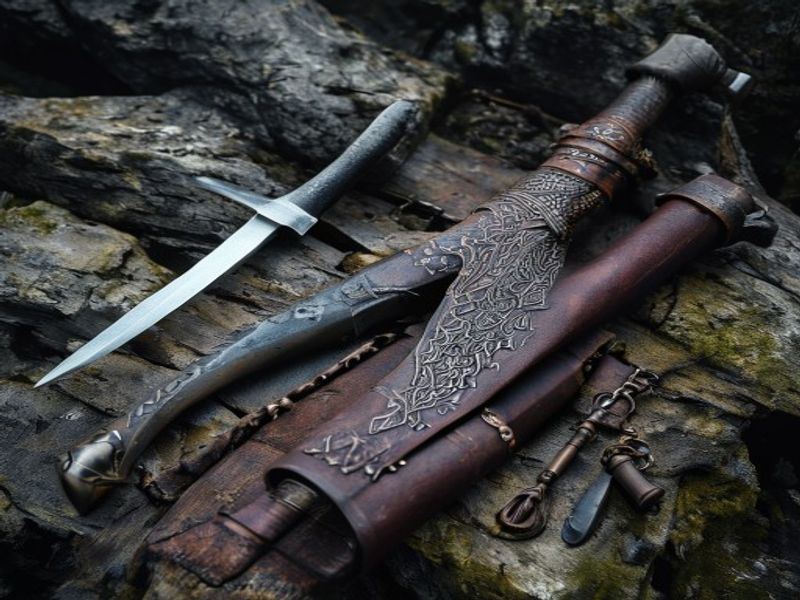
Viking Seax Knife & Leather Tool Roll
Large seax knife (12-inch single-edge blade) and leather roll with fire steel, whetstone, and bone needles. The seax was tool, weapon, and eating knife in one. Every Norseman carried one. Mine has a pattern-welded blade -- the maker's signature in the steel.

Mercenary Leadership Workshop -- Building a Free Company
How to build, supply, and command a private army. Recruitment, pay structure, loyalty management, negotiating with patrons. I conquered Valencia with a freelance army because no king would give me one. Tip: Pay your men on time, every time. A soldier who trusts your purse will trust your orders.

Arabian Saif Sword (Curved, Early Islamic Period)
Early Islamic saif -- gently curved, 34-inch blade, ideal for mounted combat. Lighter than the European longsword, faster in the draw. I broke nine swords at Uhud in a single battle. A warrior needs a blade that matches his speed.


Battle Tempo Masterclass -- Controlling the Fight
How to dictate the pace of a battle. When to attack, when to feint, when to commit reserves. In over 100 battles, I never let the enemy choose the moment of decision. Tip: The commander who controls the tempo controls the outcome. Make them react to you, never the reverse.
Woodland Warfare & Ambush Tactics
Fighting in the eastern forests. Ambush placement, tree-line defense, river crossing interdiction. The Shawnee were masters of woodland warfare -- we knew every trail, every crossing, every blind turn. Tip: In the forest, the defender is invisible and the attacker is blind. Make the forest your ally.


Grand Strategy Seminar -- The Longzhong Plan Method
How to assess a strategic landscape and create a multi-year plan. Alliance building, resource assessment, timing, and the patience to wait for conditions to ripen. I planned Liu Bei's rise from a homeless refugee to Emperor of Shu Han. Tip: Strategy is not a single move. It is a sequence of moves that each make the next one possible.


Military Engineering Workshop -- Build What You Need
The wooden ox, the repeating crossbow, fire weapons, pontoon bridges. How to solve military problems with engineering. I built transport systems for mountain supply lines that kept Shu Han's armies fed in impossible terrain. Tip: The engineer wins more battles than the swordsman. The swordsman fights the battle. The engineer decides whether there will be one.

Chinese Dao Sword (Northern Wei Style)
Single-edged dao, 32-inch blade, ring pommel. The standard infantry sword of the Northern Wei period. Optimized for cutting from horseback -- the slight curve pulls the blade through the target. I carried one for twelve years and it never failed me.


Mounted Combat Training -- Fight From the Horse
Bareback mounted combat with lance, bow, and war club. The Lakota fought from horseback as naturally as walking. Hanging off the side of the horse as a shield, shooting under the neck, the full-speed charge. Tip: Your war paint is your identity. I painted a lightning bolt on my face and hail spots on my body. The enemy should know who is coming for them.

109-120 of 192 items (page 10 of 16)